
Criminal Cases in the Lee County Courts
Lee County is part of Kentucky's 23rd Judicial Circuit and District. Circuit Court hears felony prosecutions and imposes felony sentences. District Court handles misdemeanors, violations, traffic cases, ordinance matters, and the early stages of a felony accusation. A single event may therefore create a District Court filing before an indictment creates a Circuit Court case. Those are linked stages, not proof of two convictions.
The Lee Circuit Court Clerk keeps both courts' files. Clerk Tyler Phillips's office is on the second floor at 256 Main Street in Beattyville. The public counter is open weekdays from 8 a.m. to 4 p.m., and the clerk can be reached at 606-464-8400. Beattyville does not publish a separate municipal criminal-case portal. City ordinance and misdemeanor cases route through Lee District Court.
Lee County District and Circuit Searches
Search both court levels when the record concerns a possible felony. A District Court entry may use an “F” case type for the preliminary phase. After a grand jury returns an indictment, Circuit Court activity may appear under a “CR” number. Misdemeanor and traffic activity can appear as “M” and “T.” The label identifies a Kentucky court track. It does not state the final outcome.
Chief Circuit Judge Michael Dean handles Circuit Court matters, while District Judge William “Bo” Leach handles District Court matters according to the official Lee court page. Judge names can help distinguish docket entries, but the court, division, case number, and dates are more reliable search keys. Check amendments and the disposition rather than stopping at the original charge.
- Original charge
- The charge shown when the court record began.
- Amended charge
- A charge changed during the case process.
- Disposition
- The recorded procedural outcome for a charge or case.
- Indictment
- A grand-jury accusation that permits felony prosecution, not a finding of guilt.
Note: A filed charge may change, so read the amendment and disposition fields before drawing a conclusion from the first docket entry.
How to Search Case Records
Kentucky offers Find a Court Date for public docket queries and CourtNet 2.0 for registered subscribers. Find a Court Date is useful for a scheduled appearance. It is not a full criminal history or a certified disposition. CourtNet provides broader statewide case information, but access and subscription limits apply. The clerk remains the source for the underlying Lee County order.
- Open the court-date service or the appropriate CourtNet access point.
- Select Lee County, then choose District or Circuit when the interface offers a division.
- Use the known docket date and exact party or case details. Repeat the query at the other court level when a felony may have advanced.
- Record the case number, court, charge, amendments, hearing dates, and disposition shown.
- Call or visit the Lee clerk for the signed order, judgment, or certified copy needed.
| Field Label | Type | Required | Notes |
|---|---|---|---|
| County | Dropdown | Yes | Select Lee. |
| Court or division | Dropdown | Depends on view | Choose District or Circuit where offered. |
| Date | Date or dropdown | Yes | Use the docket date, not the arrest date. |
| Party or case details | Text | Optional if shown | Use exact spelling or the case number. |
| Search or Submit | Button | Yes | Runs the selected docket query. |
A missing result means the chosen query returned no matching docket. It does not establish that no Lee County case exists. Very new filings can lag, and old material may no longer be in the same online view.
Lee County CourtNet and Clerk Records
The CourtNet search interface offers a useful first look at Kentucky case information. The captured Lee County image below shows the official statewide entry point. Access shown on the live system may depend on account status, and guest views may not include document images.
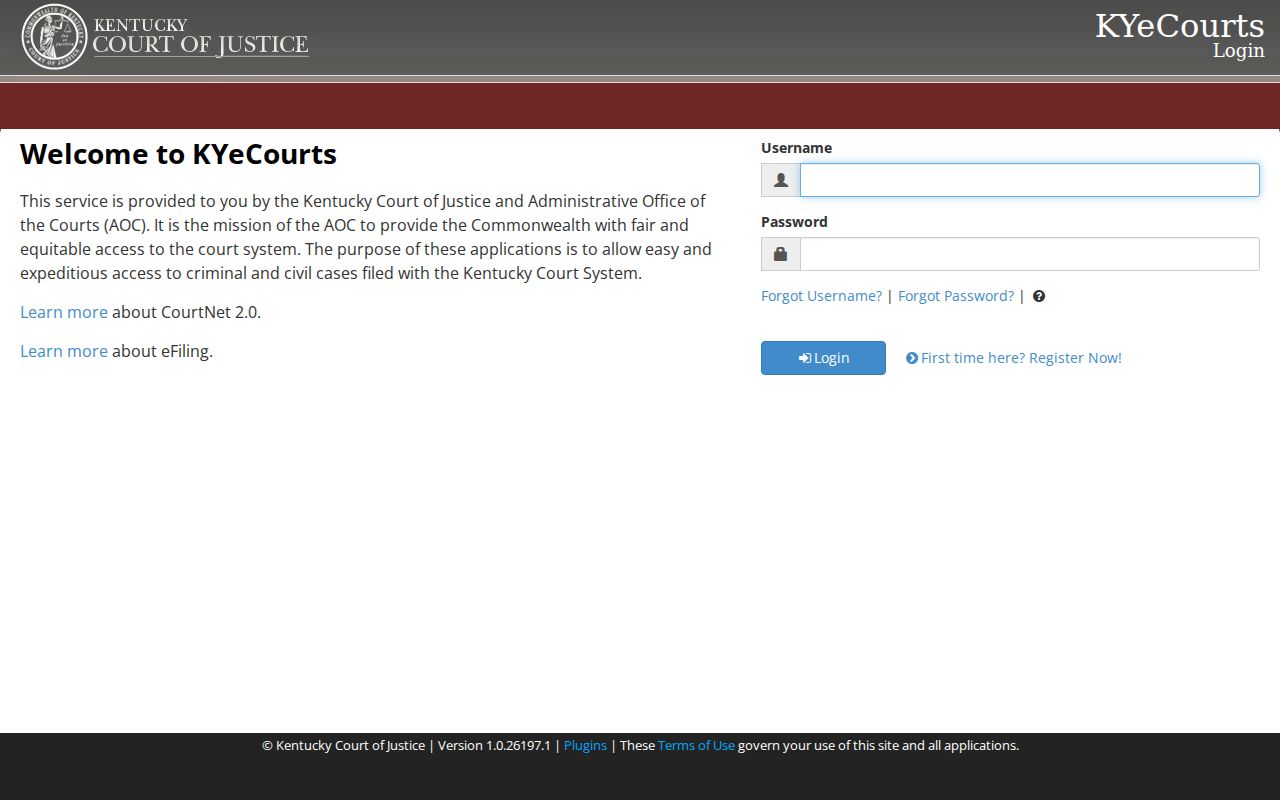
The interface helps identify a court record, but the Lee clerk supplies the file that proves what the judge signed. If the screen shows a disposition without the order itself, request the judgment or disposition order by case number. Plain-copy, certified-copy, and local search fees were not published on the Lee court page, so ask the clerk for the current amount before ordering.
Lee Circuit Court Clerk
256 Main Street, second floor
Beattyville, KY 41311
606-464-8400
Fax: 606-464-0144
What the Case File Shows
A Lee County criminal case file can show how an accusation changed after filing. Read it as a sequence. The complaint or indictment states an allegation; docket entries log court activity; a plea or verdict records adjudication; and the judgment and sentence state the ordered result. Financial entries may show fines and costs. Public attorney and prosecutor appearances can also appear.
| Case Number & Court | Identifies Lee County, the division, case type, and unique file. |
|---|---|
| Charging Document | Shows the complaint, citation, or indictment and the alleged offense. |
| Docket Entries | Chronological notices, motions, hearings, pleas, and orders. |
| Hearing Dates | Lists scheduled or completed events with court and judge details when public. |
| Disposition & Judgment | Records dismissal, acquittal, conviction, or another procedural outcome and the signed ruling. |
| Sentence & Conditions | States confinement, probation, costs, restitution, or other terms ordered after conviction. |
Compare the disposition at the charge level with the final judgment. One charge may be dismissed while another ends in conviction. An AOC statewide court report can summarize county, case number, original charge, amendments, and disposition dates, but AOC states that report is not an official signed court record.
Older Lee County Criminal Case Files
An old case may be absent from the current web view even though a retrievable file still exists. Ask the clerk whether it remains at the counter, has moved to a records facility, or was destroyed under an approved retention schedule. If it moved, the clerk can provide the facility and the case or file-locator numbers needed to request it.
Call before making the mountain trip to Beattyville. The courthouse offers free two-hour parking around the building, but archive retrieval may not be immediate. Ask about current copy charges, certification, access needs, and whether staff need advance notice. A certified judgment bears the clerk's authentication and is more useful than a screen print when the exact court action matters.
Note: The clerk counter is the decisive local source when an older record, signed order, or certified disposition is not available online.
Stages of a Criminal Case
Kentucky's path depends on the charge. A misdemeanor can remain in Lee District Court through disposition. A felony normally has an initial appearance and preliminary process there before an indictment moves prosecution to Circuit Court. Pretrial motions and discovery occur before a plea or trial. The judgment records the outcome, and sentencing follows a conviction. An appeal creates another stage only when one is taken.
Case flow: Charges Filed → Arraignment → Pretrial → Plea or Trial → Disposition → Sentencing
The exact docket controls. An arrest charge may be amended, dismissed, or replaced by an indictment. “Nolle prosequi” means the prosecutor formally chose not to continue a charge at that time. It does not describe a conviction. Likewise, a dismissal is a disposition, but the underlying public entry does not vanish merely because the charge ended.
Lee County Criminal Courts on Main Street
Lee County keeps an unusually compact court-record route. Circuit Court, District Court, and the clerk who holds both files share the courthouse at 256 Main Street. The sheriff is also based in the building, but the offices hold different records. Ask the clerk for the filed case, docket, order, or judgment. Ask the sheriff for an agency report or arrest record the sheriff created.
This split matters when a name appears in only one place. A police report may exist before prosecutors file a court case. A District Court matter may end without a Circuit file. A Circuit judgment can remain available after custody ends. State the record type when calling so staff can route the request to the right custodian.
Lee County Filed Charges and Outcomes
A booking record captures the charges used to hold a person at intake. A court file shows what prosecutors actually filed and what the court later did. These sources answer different questions. The court file is best for arraignment, motions, pleas, orders, disposition, and sentence. For the prior custody event and agency narrative, consult the separate Lee County arrest history channels.
Kentucky's offense classes also help explain the court path. Class A through D felonies are heard in Circuit Court. Class A and B misdemeanors, violations, and traffic matters are heard in District Court. A class label is not enough to decide expungement eligibility, and it does not replace the judgment. Read the cited offense, charge history, and final order together.
| Record | Best evidence of | Main limit |
|---|---|---|
| Booking entry | Intake, holding charge, bond, and custody snapshot | Charge may later change |
| Court docket | Filed charges and procedural events | May omit the document image |
| Signed judgment | Final adjudication and sentence | Must be obtained from the clerk when not online |
Access & Restrictions
Kentucky court records are generally available through the court custodian, but public access is not universal. Juvenile matters and other confidential case types are excluded from routine public AOC products. Sensitive identifiers, victim information, and sealed or expunged material may be withheld or redacted. A public docket can therefore show less than the paper file, while the paper file can also contain protected portions the clerk cannot release.
For a copy, use the local clerk rather than a general county open-records request. The Kentucky court-record request instructions distinguish case records held by circuit clerks from administrative records held elsewhere. Give Lee County, the court level, case number, party name, and approximate year. State whether a plain copy or certified copy is needed.
Public does not mean complete: A sealed, expunged, confidential, archived, or not-yet-indexed file may not appear in a guest search. Ask the Lee clerk what access rule applies.
Under the Kentucky Open Records Act, agency records follow statutory access and exemption rules, but judicial case-file access begins with the court custodian. Never treat a blank web result as proof that a person has no case.